
Turing Complete refers to a computational system that can solve any problem given enough time and memory, making it the gold standard for programmable blockchains and smart contracts.
Key Takeaways
- One‑line definition: A system capable of performing any computation that a universal Turing machine can.
- Core features include unlimited conditional logic, loops, and state storage.
- Real‑world application: Enables complex decentralized finance (DeFi) protocols on platforms like Ethereum.
- Compared to non‑Turing‑complete chains, it offers far richer programmability at the cost of higher attack surface.
- Risk warning: Greater expressiveness can lead to bugs, exploits, and higher gas costs.
What Is Turing Complete?
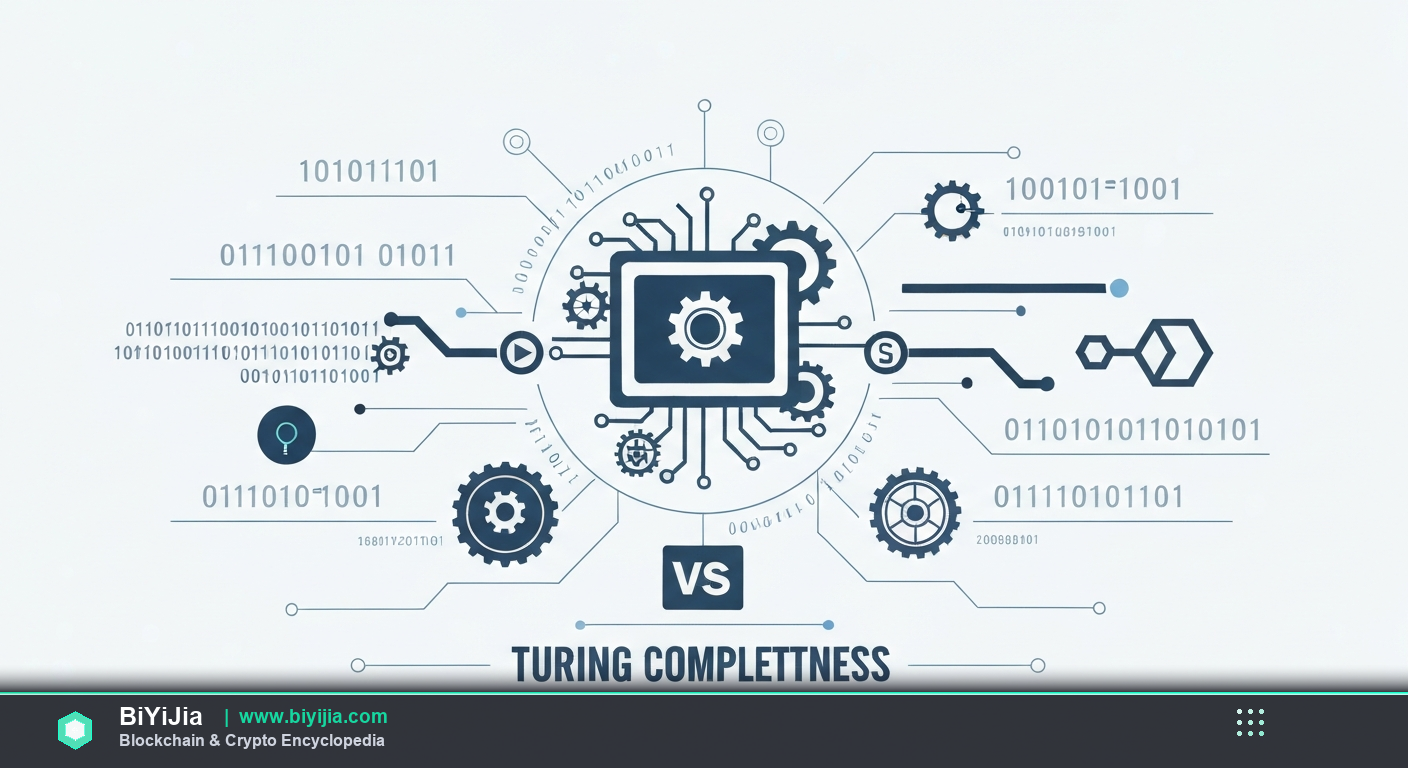
In plain English, Turing complete means a blockchain or programming language can, in theory, compute anything that any other computer can compute.
Technically, the concept comes from Alan Turing’s 1936 paper where he described a simple abstract machine that manipulates symbols on an infinite tape according to a set of rules. If a system can simulate that machine—meaning it supports conditional branching, loops, and an unbounded memory model—it earns the Turing complete badge. In blockchain terms, that translates to the ability to write arbitrary logic inside smart contracts, rather than being limited to a fixed set of transaction types.
Think of Turing completeness like a Swiss Army knife versus a single‑purpose screwdriver: the knife can handle any job if you have the time and patience, while the screwdriver can only turn screws. Likewise, a Turing‑complete blockchain can handle any decentralized application, but you need to manage complexity and security.
How It Works
- Developers write code in a high‑level language (Solidity, Vyper, etc.) that expresses the desired logic.
- The code is compiled down to bytecode that the blockchain’s virtual machine (EVM, WASM, etc.) can execute.
- The virtual machine interprets the bytecode, step by step, using the network’s consensus rules to validate each operation.
- State changes (balances, contract storage, etc.) are recorded on the ledger, making the computation deterministic across all nodes.
- Gas fees are charged for each computational step, preventing infinite loops and ensuring economic feasibility.
Core Features
- Unbounded Conditional Logic: Ability to execute "if‑else" statements and complex branching.
- Loops and Recursion: Support for repeating actions until a condition is met, enabling iterative processes.
- Persistent State: Contracts can store data that persists across transactions, essential for DeFi and NFTs.
- Deterministic Execution: Every node arrives at the same result, guaranteeing consensus.
- Composable Architecture: Contracts can call other contracts, building layered applications.
- Gas Metering: Economic throttling that charges for each operation to avoid abuse.
Real-World Applications
- Ethereum: Hosts millions of Turing complete smart contracts; as of 2026, over 200 million contracts have been deployed (Etherscan, 2026).
- Solana: Uses a Rust‑based runtime that is Turing complete, powering high‑throughput DeFi apps like Serum.
- Polkadot: Its parachains run WebAssembly (WASM), a Turing complete environment enabling cross‑chain smart contracts.
- Arbitrum: An optimistic rollup that inherits Ethereum’s Turing completeness while scaling transaction throughput.
- Cardano (Alonzo): Introduced Plutus scripts, granting Turing complete capabilities for complex financial contracts.
Comparison with Related Concepts
Turing Complete vs Bitcoin Script: Bitcoin Script is deliberately non‑Turing complete; it lacks loops, which makes it safer but limits on‑chain programmability to simple payment conditions.
Turing Complete vs Ethereum: Ethereum’s EVM is the poster child of Turing completeness in blockchain, whereas earlier platforms like Ripple or Stellar offer limited, purpose‑built transaction types.
Turing Complete vs Traditional Programming Languages: Languages like Python or Java are Turing complete by default, but on a blockchain they must operate under deterministic, gas‑metered constraints.
Risks & Considerations
- Security Vulnerabilities: Complex code can harbor bugs like re‑entrancy, leading to high‑profile exploits (e.g., DAO hack).
- Gas Inflation: Unlimited loops can consume excessive gas, making transactions prohibitively expensive.
- Upgrade Complexity: Changing contract logic often requires proxy patterns, which add another layer of risk.
- State Bloat: Persistent storage can grow unchecked, increasing node storage requirements.
- Regulatory Scrutiny: Highly programmable contracts may fall under securities or financial regulations in various jurisdictions.
Embedded Key Data
According to Dune Analytics, Ethereum’s daily gas consumption for Turing complete contracts averaged 85 million gas units in Q1 2026, representing a 12% increase YoY. Meanwhile, a 2026 survey by ConsenSys found that 68% of DeFi developers consider Turing completeness essential for building innovative financial primitives.
Frequently Asked Questions
What does "Turing complete" actually mean for a blockchain?
It means the blockchain’s virtual machine can execute any algorithm that a universal Turing machine can, given enough time and memory. In practice, this translates to the ability to write arbitrarily complex smart contracts, from simple token transfers to multi‑step financial derivatives.
Why is Turing completeness important for DeFi?
DeFi applications often require conditional logic, loops, and stateful interactions—features only a Turing‑complete environment can provide. Without it, you’d be limited to basic token swaps and static lending pools.
Can a Turing‑complete blockchain be unsafe?
Yes. The same flexibility that allows sophisticated contracts also opens doors for bugs and exploits. Developers must follow rigorous audit practices, and users should be aware of the higher risk profile compared to non‑Turing‑complete systems like Bitcoin.
Is there a performance trade‑off for Turing completeness?
Generally, yes. More expressive code requires more computation, which translates to higher gas fees and longer block times. Layer‑2 solutions and rollups aim to mitigate these costs while preserving full programmability.
How does Turing completeness relate to smart contract languages?
Languages such as Solidity, Vyper, and Rust compile down to bytecode that runs on a Turing‑complete virtual machine. The language itself isn’t the source of completeness; it’s the underlying VM that provides the computational universality.
Will all future blockchains be Turing complete?
Not necessarily. Some designers prioritize security and scalability over flexibility, opting for domain‑specific languages that deliberately avoid full Turing completeness. The ecosystem will likely continue to host both paradigms.
Summary
Turing Complete denotes a system capable of executing any computable algorithm, a property that powers the rich ecosystem of programmable blockchains and DeFi. Understanding its benefits and risks helps you navigate the trade‑offs between flexibility, security, and cost.