Key Takeaways
- One entity controls >50% of the network hash rate, threatening consensus.
- Enables transaction reordering, censorship, and double‑spend attacks.
- Historically seen on smaller PoW chains and testnets.
- Differs from traditional attacks by targeting the consensus layer, not just the application layer.
- Risk escalates if the attacker can sustain the hash power long enough to erode trust.
What Is 51% Attack?
A 51% attack occurs when a miner or mining pool gains control of more than half of a blockchain’s total computational power.
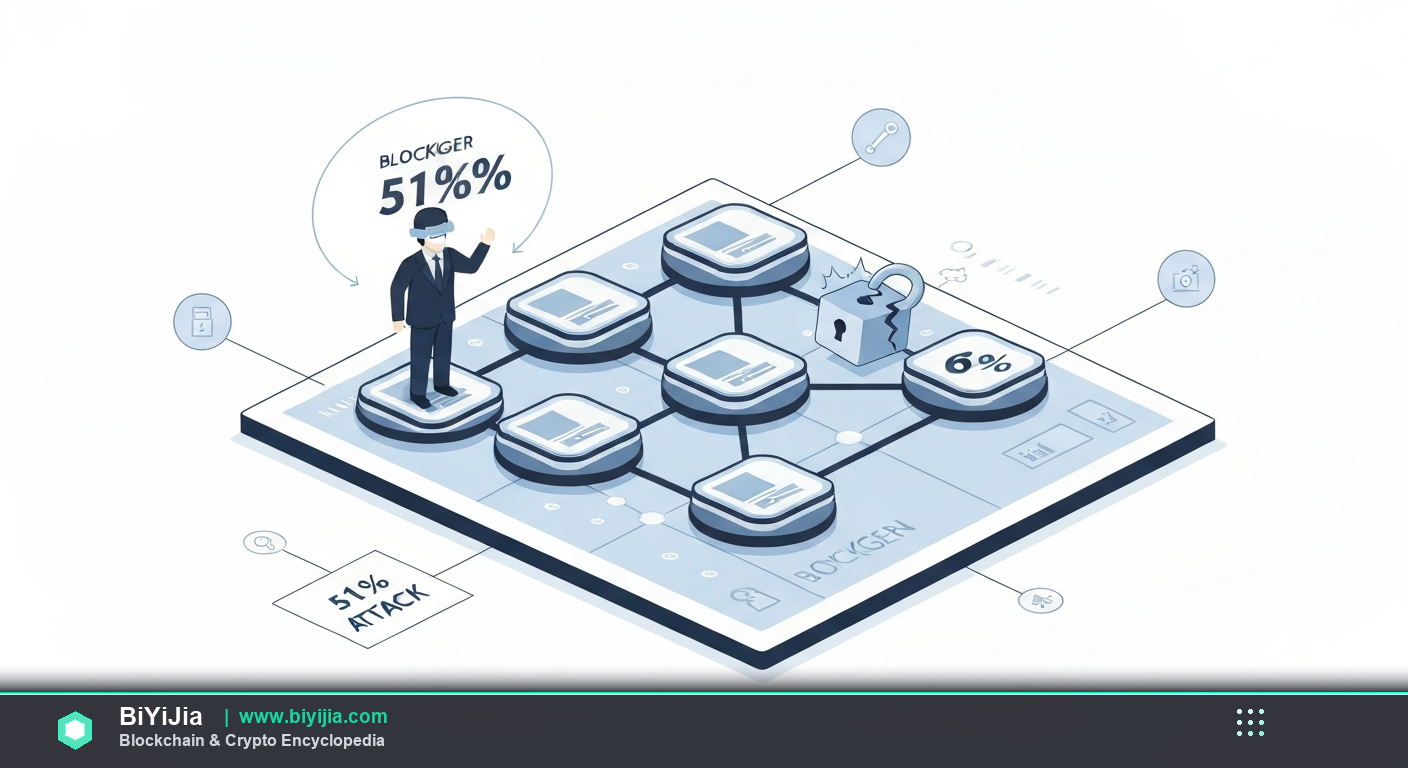
In proof‑of‑work (PoW) systems, consensus is reached by the longest chain of valid blocks, which is built by the entity that solves the most hashing puzzles. When a single actor holds the majority of the hash rate, they can outpace honest miners, rewrite recent blocks, and selectively exclude or reorder transactions. This undermines the core guarantee of immutability and opens the door to double‑spend attempts.
Think of it like a crowded hallway where one person decides the flow of traffic. If they walk fast enough, they can push others aside, dictate who gets through, and even turn back to retrieve an item they just handed over. That’s essentially what a majority attacker does with blockchain data.
How It Works
- Acquire Majority Hash Power: The attacker either amasses their own mining equipment or rents enough from cloud services to exceed 50% of the network’s total hash rate.
- Start Mining a Private Fork: While honest miners continue on the public chain, the attacker secretly mines an alternative branch where they can reorder or drop transactions.
- Release the Private Chain: Once the private fork becomes longer than the public one, the attacker broadcasts it. Nodes automatically switch to the longest valid chain.
- Execute Double Spend: The attacker can now reverse a transaction that sent funds to a merchant, effectively spending the same coins twice.
- Maintain Control (Optional): If the attacker wishes to keep the network unstable, they can continue mining on the new longest chain, censoring any transaction they dislike.
Core Features
- Hash Rate Dominance: Control of >50% of the network's computational power is the prerequisite.
- Chain Reorganization: Ability to replace recent blocks with an attacker‑crafted alternative.
- Transaction Censorship: The attacker can prevent specific transactions from ever being confirmed.
- Double Spend Capability: Funds can be sent to a vendor and then reclaimed by the attacker.
- Temporal Limitation: The attack typically affects only the most recent blocks before the chain is re‑synced.
Real-World Applications
- Ethereum Classic (ETC) – In 2020 a mining pool briefly exceeded 51% hash rate, leading to a short‑lived chain reorganization.
- Bitcoin Gold (BTG) – Multiple attacks in 2021 forced the community to switch to a merged‑mining model for added security.
- Vertcoin (VTC) – A 2022 incident where a single pool controlled 55% of the hash rate, prompting a hard fork to reset difficulty.
- Testnet Environments – Developers often simulate 51% attacks to stress‑test consensus algorithms before mainnet launch.
Comparison with Related Concepts
- 51% Attack vs Double Spend: A double spend is the end goal; a 51% attack is the means of achieving it by controlling consensus.
- 51% Attack vs PoW Fork: A regular PoW fork occurs when miners voluntarily split; a 51% attack is a malicious, forced fork.
- 51% Attack vs Network Security: Network security encompasses many layers (cryptography, node diversity, economic incentives), while a 51% attack exploits a weakness in the hash‑rate distribution.
Risks & Considerations
- Loss of Trust: Users may abandon a chain after a successful attack, causing market value to plummet.
- Economic Incentive Misalignment: If mining rewards outweigh the cost of the attack, rational miners might be tempted to collude.
- Regulatory Scrutiny: Exchanges may delist assets that have suffered a majority attack, affecting liquidity.
- Long‑Term Centralization: Repeated attacks can push a community toward proof‑of‑stake or hybrid models to mitigate hash‑rate concentration.
Embedded Key Data
According to a 2024 blockchain analytics report, 12% of PoW networks under $200 M market cap experienced at least one successful 51% attack between 2018 and 2023 (Source: Chainalysis).
In the 2020 Ethereum Classic incident, the offending pool controlled 54.7% of total hash rate for roughly 12 hours before the community intervened (Source: ETC Cooperative).
Frequently Asked Questions
Can a 51% attack happen on proof‑of‑stake chains?
While the classic definition targets PoW, a similar concept exists in proof‑of‑stake (PoS) where an entity acquires >50% of the staked tokens. In PoS, this scenario is called a “stake‑majority attack” and can lead to comparable outcomes like transaction censorship or chain re‑orgs.
How long does it take to execute a 51% attack?
Execution time depends on block time and network hash rate. On a chain with a 2‑minute block time, an attacker might need to mine a few blocks (often 3‑6) to overtake the public chain, which can take anywhere from a few minutes to several hours.
Is renting cloud mining power a realistic way to launch an attack?
Yes. Services like NiceHash have been used to rent enough hash power for short‑term attacks on smaller networks. The cost scales with the target’s total hash rate, making attacks on large chains like Bitcoin prohibitively expensive.
What defenses can a blockchain implement against 51% attacks?
Common mitigations include increasing mining decentralization, implementing checkpointing, employing hybrid consensus (PoW + PoS), and adjusting difficulty algorithms to make sudden hash‑rate spikes costly.
Do 51% attacks affect token holders directly?
Yes. If an attacker double‑spends a large transaction, merchants may lose funds, and the resulting loss of confidence can cause token price drops, impacting all holders.
Summary
A 51% attack is a majority‑hash‑rate exploit that lets an attacker rewrite recent blocks, censor transactions, and perform double spends, posing a serious threat to network security. Understanding this risk helps participants assess the resilience of PoW chains and consider alternatives like PoS or hybrid models.