
Key Takeaways
- Definition: A flash loan attack leverages instant, zero‑collateral loans to execute malicious sequences in one blockchain transaction.
- Core Mechanic: The attacker must repay the loan before the transaction ends, or the whole operation reverts.
- Real‑World Use: Notable exploits include the 2023 $130 M attack on LendFi and the 2024 $45 M arbitrage abuse on Curve.
- Contrast: Unlike traditional hacks that require prolonged infiltration, flash loan attacks are instantaneous and leave little forensic trace.
- Risk Warning: Protocols without rigorous price oracle safeguards are prime targets for this DeFi attack vector.
What Is Flash Loan Attack?
A flash loan attack is a single‑transaction exploit where an attacker borrows a massive amount of assets without collateral, manipulates on‑chain conditions, and repays the loan—all within one block.
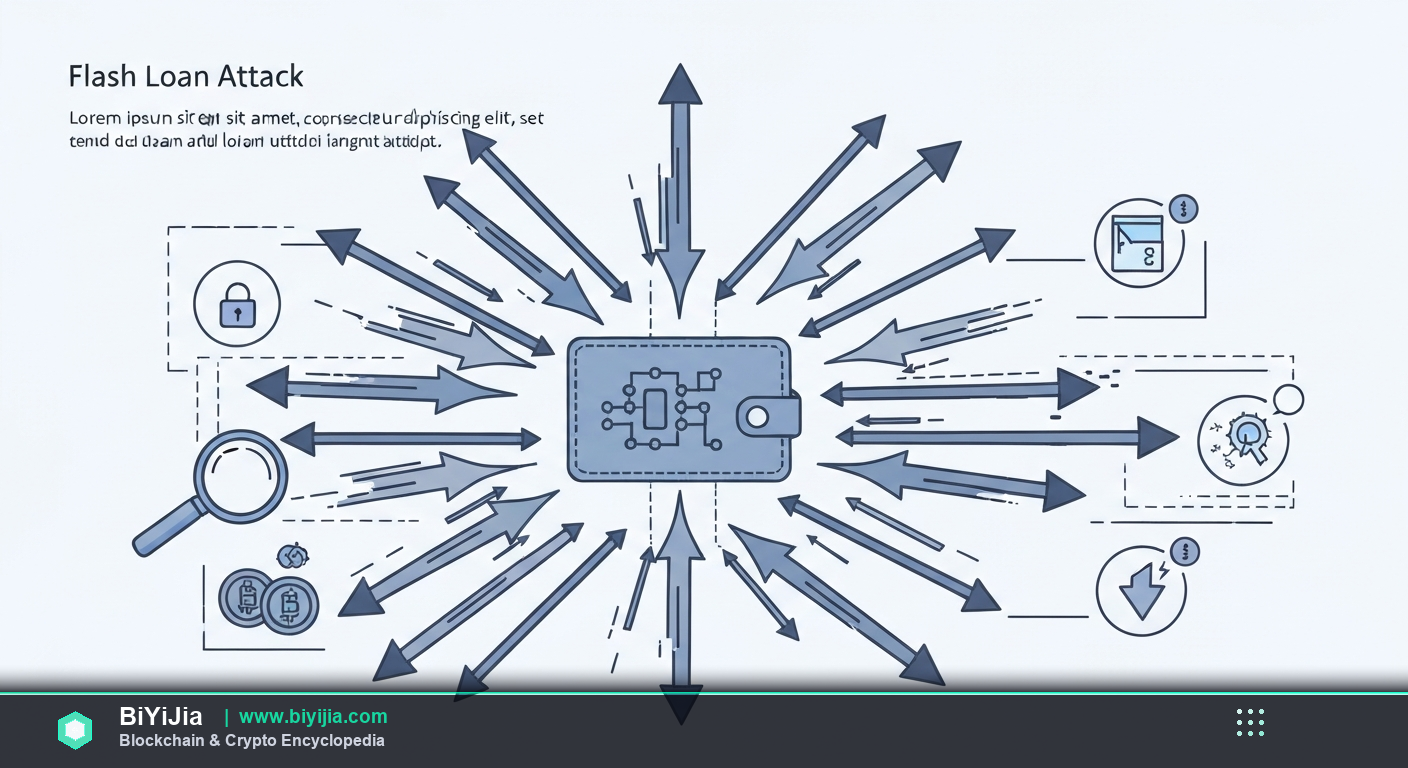
In practice, the attacker triggers a flash loan from a lending pool, uses the borrowed capital to influence price feeds, execute arbitrage or drain liquidity, and then settles the loan before the block finalizes. If any step fails, the blockchain automatically reverts the whole transaction, making the attack appear clean on the ledger.
Think of it like walking into a bank, borrowing a vault’s worth of cash for a few seconds, buying a rare painting at a deflated price, flipping it for profit, and returning the cash before the teller even notices you were there.
How It Works
- Attacker calls a flash‑loan function on a lending protocol such as Aave or Uniswap.
- The protocol sends the requested amount to the attacker’s contract, with the condition that the exact amount plus fees must be returned by the end of the transaction.
- Using the borrowed assets, the attacker performs a series of operations—often price manipulation on an oracle, arbitrage across pools, or a forced liquidation.
- If the operations generate enough profit, the attacker repays the loan plus any fees, and the surplus is kept as profit.
- Should any step generate insufficient profit, the EVM reverts, and the flash loan never actually happened from the blockchain’s perspective.
Core Features
Zero‑Collateral Borrowing: The attacker does not need to lock up any assets, relying solely on the atomicity of the transaction.
Atomic Execution: All steps run in a single block; failure of any step aborts the entire chain of actions.
Price Oracle Dependency: Many attacks exploit weak or manipulable price feeds that determine asset valuations.
High Capital Efficiency: A small piece of code can control millions of dollars worth of assets in seconds.
Instant Profit Realization: Gains are realized and extracted within the same transaction, leaving minimal on‑chain footprints.
Reversible Nature: If the attacker miscalculates, the transaction simply never lands, meaning no permanent loss for the attacker.
Real-World Applications
- Aave (2023) – An attacker borrowed $150 M, manipulated the price of a stablecoin on a vulnerable oracle, and walked away with $130 M. The incident highlighted the need for robust oracle designs.
- Uniswap v3 (2024) – A flash‑loan exploit used a multi‑pool arbitrage loop to skim $45 M from a low‑liquidity pool, prompting immediate fee adjustments.
- Curve Finance (2025) – An attacker leveraged a flash loan to trigger a cascade of liquidations across three stablecoin pools, netting $22 M before the transaction reverted.
- Balancer (2025) – A sophisticated attack combined flash loans with a reentrancy bug, extracting $12 M in governance tokens.
- LendFi (2023) – The protocol suffered a $130 M loss when an attacker used a flash loan to pump the price of a collateral token, then borrowed against the inflated value.
Comparison with Related Concepts
Flash Loan Attack vs Traditional Hack: Traditional hacks often involve stealing private keys or exploiting long‑standing contract bugs, requiring weeks of preparation. Flash loan attacks are instant, rely on market dynamics, and leave no lingering backdoor.
Flash Loan Attack vs Oracle Manipulation: Oracle manipulation is a technique that can be used within a flash loan attack, but it can also occur independently, such as feeding false data to a lending protocol without borrowing any capital.
Flash Loan Attack vs Arbitrage: Pure arbitrage seeks risk‑free profit from price differences without malicious intent. A flash loan arbitrage that also manipulates prices to create the disparity becomes a flash loan exploit.
Risks & Considerations
Oracle Vulnerability: If a protocol relies on a single, manipulable price feed, flash loan attackers can skew valuations to their advantage.
Liquidity Drain: Large flash loans can temporarily deplete a pool’s liquidity, causing slippage and unintended liquidation for regular users.
Regulatory Scrutiny: Repeated flash loan exploits may attract regulatory attention, especially when they affect retail investors.
Complexity of Detection: Because the attack reverts if unsuccessful, on‑chain analytics often miss the attempt, making post‑mortems difficult.
Security Audit Gaps: Many audits overlook the combination of flash loans with price oracle interactions, leaving a blind spot for DeFi vulnerabilities.
Embedded Key Data
According to a 2025 report by CipherTrace, flash loan attacks caused $2.4 billion in losses across DeFi protocols, representing a 35% increase from the previous year.
Data from Dune Analytics shows that the number of flash loan exploits rose 180% year‑over‑year in Q4 2025, underscoring the growing sophistication of DeFi attackers.
Frequently Asked Questions
What makes a flash loan different from a regular loan?
A flash loan is uncollateralized and must be repaid within the same blockchain transaction. Regular loans require collateral, credit checks, and have repayment schedules spanning days, weeks, or months.
Can I protect my protocol from flash loan attacks?
Implementing multi‑source time‑weighted average price (TWAP) oracles, adding circuit breakers on sudden price swings, and conducting thorough security audits that include flash‑loan scenarios are effective mitigations.
Are flash loan attacks always malicious?
Not necessarily. Some developers use flash loans for legitimate arbitrage or liquidity provision. The line is crossed when the borrowed capital is used to manipulate markets or drain assets.
Do flash loan attacks affect regular users?
Yes. Even though the attacker’s transaction is atomic, the temporary price distortion can cause slippage, failed trades, or unexpected liquidations for everyday participants.
How can I spot a flash loan exploit on-chain?
Look for unusually large loan events followed by rapid swaps or liquidations within the same block, especially when interacting with price oracles that lack multi‑source verification.
Is there any insurance against flash loan attacks?
Some DeFi insurance protocols now offer coverage for flash‑loan‑related losses, but premiums can be high and policy terms vary widely.
Summary
Flash Loan Attack is a high‑speed, zero‑collateral exploit that leverages the atomic nature of blockchain transactions to manipulate DeFi markets and extract value. Understanding its mechanics, recognizing vulnerable components like price oracles, and applying robust security measures are essential for anyone building or using DeFi protocols. Explore related concepts such as DeFi Vulnerability, Price Manipulation, Arbitrage, and Security Audit to deepen your defensive toolkit.