
ERC-721 is the Ethereum token standard that defines non-fungible tokens, enabling unique digital assets such as collectibles, artwork, and in-game items.
Key Takeaways
- One-line definition: ERC-721 is the NFT token standard for creating unique, indivisible assets on Ethereum.
- Core features include token uniqueness, metadata linking, and ownership tracking.
- Real-world application: used by platforms like OpenSea, Decentraland, and NBA Top Shot.
- Compared to ERC-20, ERC-721 tokens are non-fungible, meaning each token has its own identity.
- Risk warning: market volatility and smart‑contract bugs can affect NFT value and security.
What Is ERC-721?
In plain language, ERC-721 is the Ethereum standard that lets developers mint tokens that are each distinct and cannot be swapped on a one‑to‑one basis.
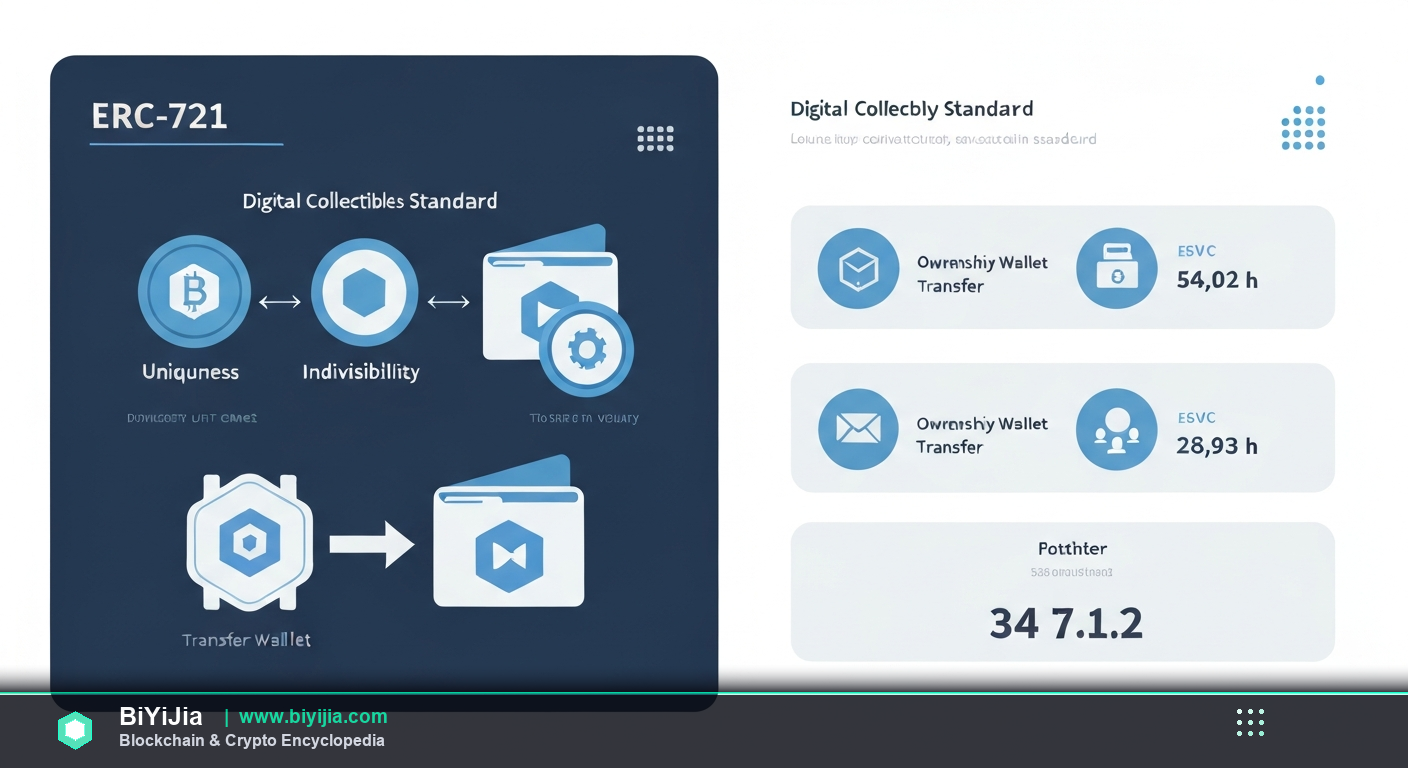
Technically, ERC-721 defines a set of required and optional functions that a smart contract must implement, such as ownerOf, balanceOf, and tokenURI. These functions let wallets and marketplaces query who owns a particular token and retrieve its associated metadata, which is usually stored off‑chain via IPFS or another decentralized storage solution.
Think of ERC-721 like a traditional baseball card collection: each card has its own serial number, player image, and stats, making it impossible to treat two cards as interchangeable even if they feature the same player.
How It Works
- Developer writes a smart contract that follows the ERC-721 interface, including functions for minting, transferring, and querying tokens.
- When a new token is minted, the contract assigns a unique identifier (token ID) and links it to metadata that describes the asset’s appearance, provenance, and attributes.
- Owners can transfer tokens using the
safeTransferFromfunction, which checks that the recipient can handle ERC-721 assets. - Marketplaces and wallets read the contract’s public functions to display ownership history and metadata to users.
- When a token is burned, its ID is removed from circulation, ensuring the total supply reflects only existing, unique items.
Core Features
Uniqueness: Each token ID is globally unique, guaranteeing that no two ERC-721 tokens are identical.
Indivisibility: Tokens cannot be split into smaller units; you either own the whole token or nothing.
Metadata Linking: The tokenURI function points to a JSON file that describes the asset, often hosted on IPFS for permanence.
Ownership Tracking: Functions like ownerOf provide a transparent ledger of who holds each token at any moment.
Transfer Safety: safeTransferFrom ensures tokens aren’t sent to contracts that don’t support ERC-721, preventing accidental loss.
Extensibility: Developers can add custom functions (e.g., royalties, upgradeability) while still complying with the base standard.
Real-World Applications
- OpenSea: The largest NFT marketplace, listing over 10 million ERC-721 items as of Q2 2026 (source: OpenSea Transparency Report).
- Decentraland: A virtual world where parcels of land are ERC-721 tokens, with total land sales exceeding $1.3 billion in 2025 (source: DCL Analytics).
- NBA Top Shot: Uses ERC-721 to represent officially licensed basketball moments; daily trade volume topped $150 million in March 2026 (source: Dapper Labs).
- Axie Infinity: Each Axie creature is an ERC-721 token, driving a play‑to‑earn ecosystem that generated $2.4 billion in revenue in 2024 (source: DappRadar).
- Art Blocks: Generates generative art where each piece is an ERC-721 token, with average secondary‑market price of 1.8 ETH per piece in 2025 (source: Art Blocks Stats).
Comparison with Related Concepts
ERC-721 vs ERC-20: ERC-20 tokens are fungible—each unit is interchangeable—while ERC-721 tokens are non-fungible, each carrying its own identity and metadata.
ERC-721 vs NFT: ERC-721 is the technical implementation of the broader NFT concept; not all NFTs use ERC-721 (e.g., ERC-1155 can mix fungible and non‑fungible items).
ERC-721 vs Digital Collectibles: Digital collectibles are the use case; ERC-721 provides the protocol that makes those collectibles provably unique and tradeable on-chain.
Risks & Considerations
Smart‑Contract Vulnerabilities: Bugs in the contract code can lead to loss of assets; audits are essential but not a guarantee.
Market Volatility: NFT prices can swing wildly; speculative buying may result in significant losses.
Metadata Centralization: If the off‑chain metadata server goes down or is altered, the visual representation of the token can disappear or be changed.
Regulatory Uncertainty: Some jurisdictions treat NFTs as securities or property, affecting tax and compliance obligations.
Gas Costs: Minting and transferring ERC-721 tokens can be expensive on congested networks, though layer‑2 solutions are mitigating this.
Embedded Key Data
According to Dune Analytics, ERC-721 contracts consumed over 12 billion gas units in 2025, representing roughly 8% of total Ethereum gas usage that year.
CryptoSlam reports that the average holding period for ERC-721 NFTs in 2024 was 57 days, indicating a relatively active secondary market.
Frequently Asked Questions
What is ERC-721 and how does it differ from ERC-20?
ERC-721 is the Ethereum standard for non‑fungible tokens, meaning each token is unique and cannot be exchanged on a one‑to‑one basis. ERC-20, by contrast, defines fungible tokens where each unit is identical and interchangeable.
Can I create my own ERC-721 token without coding?
Yes, several no‑code platforms like Mintable and OpenSea’s collection manager let you launch ERC-721 tokens by filling out a form, handling the smart‑contract deployment behind the scenes.
Do ERC-721 tokens have royalties built in?
The base ERC-721 spec does not include royalties, but many modern implementations add an optional royaltyInfo function, allowing creators to receive a percentage of each secondary‑sale.
Are ERC-721 NFTs stored on the blockchain forever?
The token ID and ownership data are on‑chain, but the actual artwork or media is usually stored off‑chain (e.g., IPFS). If the off‑chain storage fails, the token may lose its visual representation, though the on‑chain proof of ownership remains.
How do gas fees affect ERC-721 transactions?
Minting, transferring, and approving ERC-721 tokens all require gas. During network congestion, fees can spike, sometimes exceeding $100 for a single mint. Layer‑2 solutions like Polygon and Immutable X are popular ways to reduce these costs.
Is ERC-721 suitable for gaming assets?
Absolutely. Games like Axie Infinity and Illuvium use ERC-721 to represent characters, items, and land parcels, allowing true player ownership and cross‑game interoperability.
Summary
ERC-721 is the cornerstone NFT token standard that makes digital uniqueness possible on Ethereum, powering everything from art marketplaces to virtual worlds. Understanding its mechanics, benefits, and risks equips you to navigate the evolving landscape of digital collectibles, NFTs, and beyond.