Flash Loan is a unique DeFi primitive that lets you borrow assets without any collateral, as long as you return them in the same transaction.
Key Takeaways
- One‑click, uncollateralized borrowing that must be settled atomically.
- Core features include instant execution, zero upfront capital, and on‑chain enforcement.
- Most popular for arbitrage, liquidation bots, and complex composable strategies.
- Unlike traditional loans, there’s no credit check; the risk is purely smart‑contract execution.
- Mis‑execution can cause transaction revert and gas loss.
What Is Flash Loan?
In plain language, a flash loan lets you take out a short‑term loan, use the funds, and pay it back—all within a single blockchain transaction.
Technically, the loan is granted by a smart contract that checks at the end of the transaction whether the borrowed amount plus fees have been returned. If the contract sees the balance restored, the transaction succeeds; otherwise, the entire state change is rolled back, as if the loan never happened.
Think of it like a flash of lightning: you see it, you can’t hold onto it, and it disappears instantly. In the same way, the borrowed capital exists for just a heartbeat before vanishing.
How It Works
- Developer writes a smart contract that calls a flash‑loan provider (e.g., Aave).
- The provider transfers the requested assets to the contract, marking the loan as “outstanding.”
- The contract executes its custom logic—often an arbitrage trade across multiple DEXes.
- Before the transaction ends, the contract repays the principal plus a tiny fee back to the provider.
- If repayment fails, the entire transaction reverts, leaving the blockchain state unchanged.
Core Features
Zero Collateral: No need to lock up assets; the loan’s safety is enforced by code.
Atomic Execution: All steps happen in one transaction; failure triggers a full rollback.
Instant Settlement: Borrow‑use‑repay happens in seconds, limited only by block time.
Fee Structure: Typically a fraction of a basis point, e.g., 0.09% on Aave.
Composable: Can be combined with other DeFi primitives like swaps, lending, or staking within the same transaction.
Real-World Applications
- Aave: The leading flash‑loan provider, handling over $3.2 billion in cumulative loan volume in 2025 (source: Dune Analytics).
- Balancer: Uses flash loans to rebalance pools without requiring external capital.
- Uniswap V3: Arbitrage bots employ flash loans to capture price discrepancies across fee tiers.
- Euler: Offers flash‑loan‑enabled liquidation bots that protect the protocol from under‑collateralized positions.
- DyDx: Provides flash loans for leveraged trading strategies, with daily usage exceeding $150 million in 2024 (source: DeFi Pulse).
Comparison with Related Concepts
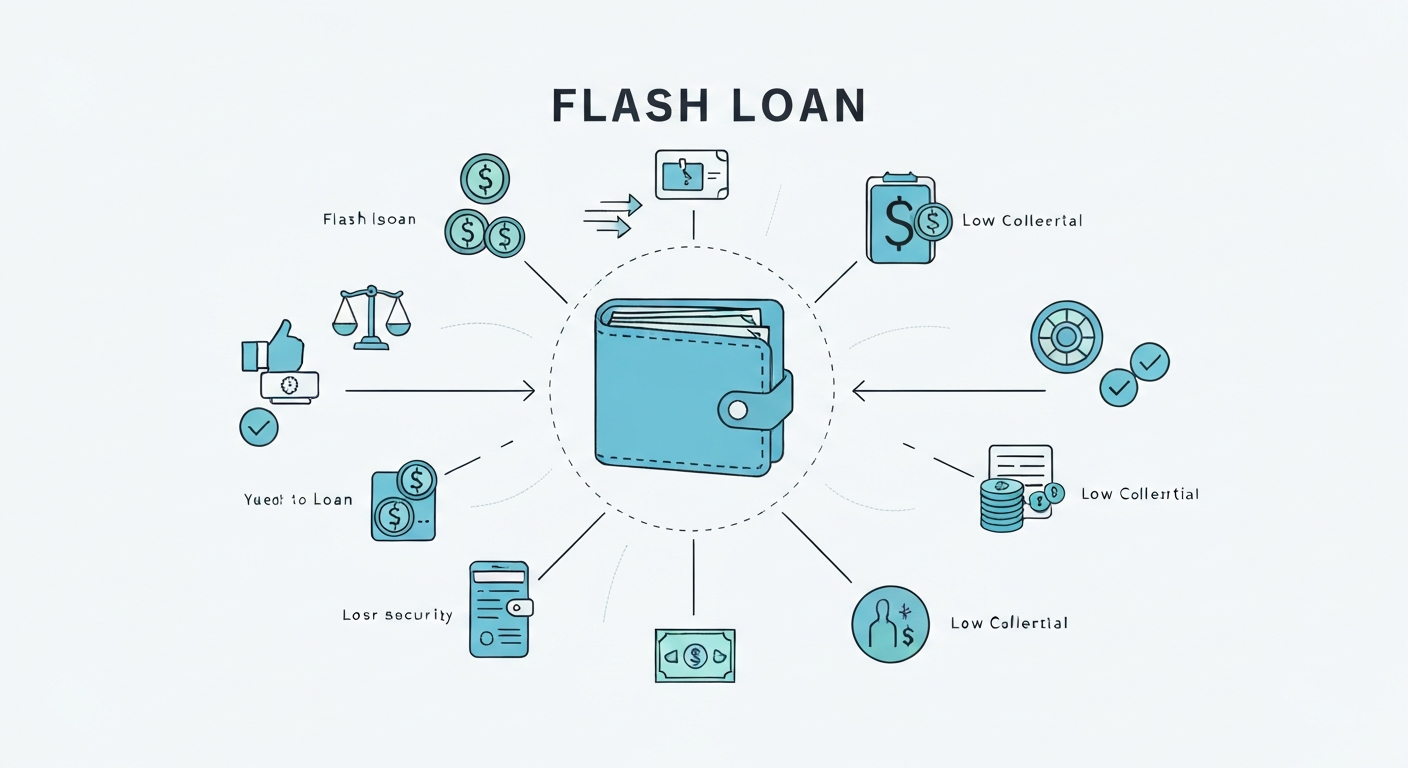
Flash Loan vs Traditional Loan: Traditional loans require credit checks and collateral, take days to settle, and accrue interest over time. Flash loans are instantaneous, uncollateralized, and fee‑only.
Flash Loan vs Uncollateralized Loan: In DeFi, “uncollateralized loan” is essentially a flash loan because the only way to enforce repayment without collateral is via atomicity. In legacy finance, uncollateralized loans exist but carry high credit risk and lengthy approval.
Flash Loan vs Atomic Transaction: An atomic transaction is a broader concept—any multi‑step operation that either fully succeeds or fully fails. Flash loans are a specific use‑case of atomic transactions that involve borrowing.
Risks & Considerations
Smart‑Contract Vulnerability: If the borrower’s contract has a bug, the loan may not be repaid, causing a revert and lost gas.
Network Congestion: High gas prices can make flash‑loan attacks uneconomical, but they also increase the cost of legitimate use.
Reentrancy Exploits: Malicious actors may try to trick the loan provider into double‑spending during the repayment step.
Regulatory Scrutiny: Flash‑loan‑driven price manipulation has attracted attention from regulators in several jurisdictions.
Fee Drain: While fees are low, repeated failed attempts can erode profitability.
Embedded Key Data
In Q4 2025, flash‑loan volume on Aave surged by 42% quarter‑over‑quarter, reaching a record $1.1 billion (source: Aave Quarterly Report). Meanwhile, DeFi Pulse reported that flash‑loan‑related arbitrage captured roughly $85 million in profit across Ethereum in 2025 alone.
Frequently Asked Questions
What is a flash loan and how can I use it?
A flash loan is an uncollateralized DeFi loan that must be repaid within the same transaction. You can use it for arbitrage, liquidation, or any strategy that can generate enough profit to cover the tiny fee before the block finalizes.
Do flash loans require any credit check?
No. Because the loan’s safety is guaranteed by the blockchain’s atomic execution, there’s no need for credit scores or collateral. The protocol simply reverts the transaction if repayment fails.
Can I lose money on a flash loan?
Yes. If your custom logic doesn’t generate enough profit to cover the fee, the transaction will revert and you’ll only lose the gas spent. Poorly written contracts can also expose you to bugs that waste funds.
Which platforms currently offer flash loans?
Major providers include Aave, Balancer, Uniswap V3 (via third‑party routers), and DyDx. Each has slightly different fee structures and supported assets.
Are flash loans safe from front‑running?
Front‑running is a real concern. Some protocols mitigate it with private transaction pools or by allowing borrowers to submit signed orders that are executed atomically, but the risk can never be fully eliminated.
How do flash loans differ from regular DeFi borrowing?
Regular borrowing locks up collateral and spans multiple blocks, incurring interest over time. Flash loans are instantaneous, require no collateral, and only charge a flat fee per use.
Summary
Flash loans are a powerful, uncollateralized loan primitive that unlocks capital‑free strategies in DeFi, from arbitrage to liquidations. Understanding their mechanics, risks, and real‑world use cases is essential for anyone looking to innovate on Ethereum and beyond. Explore related concepts like Aave, Arbitrage, and Atomic Transaction to deepen your toolkit.